Wildlife Rescue Rehab and Release
 |
1-12 Week(s) |
 |
Bulawayo, Zimbabwe |
 |
Fully Furnished Accommodation |
Wildlife Rescue Rehab and Release

Program Overview
Wildlife Rescue Rehab and Release
Welcome
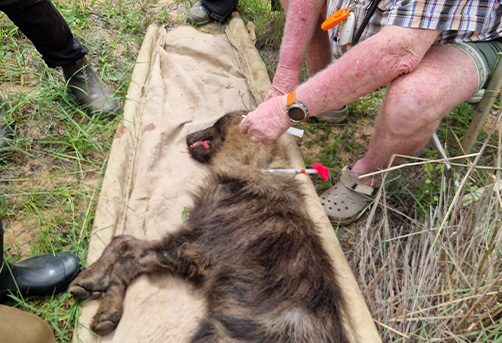
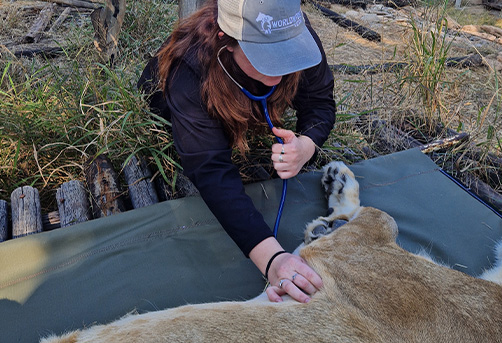
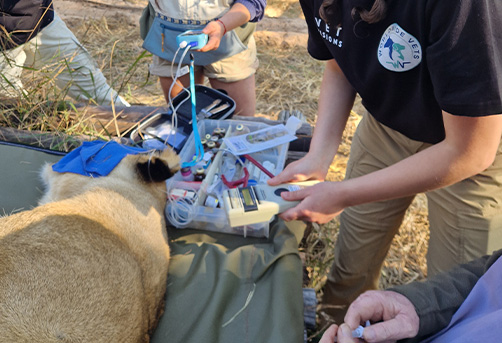
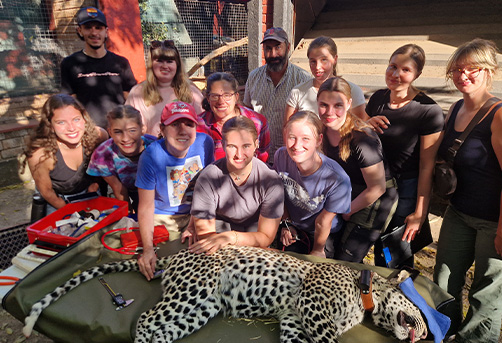
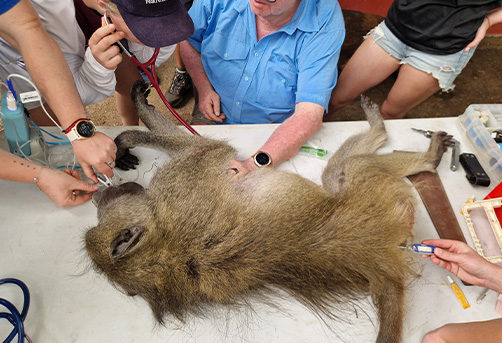
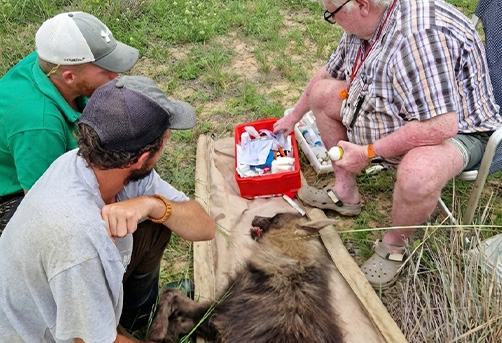
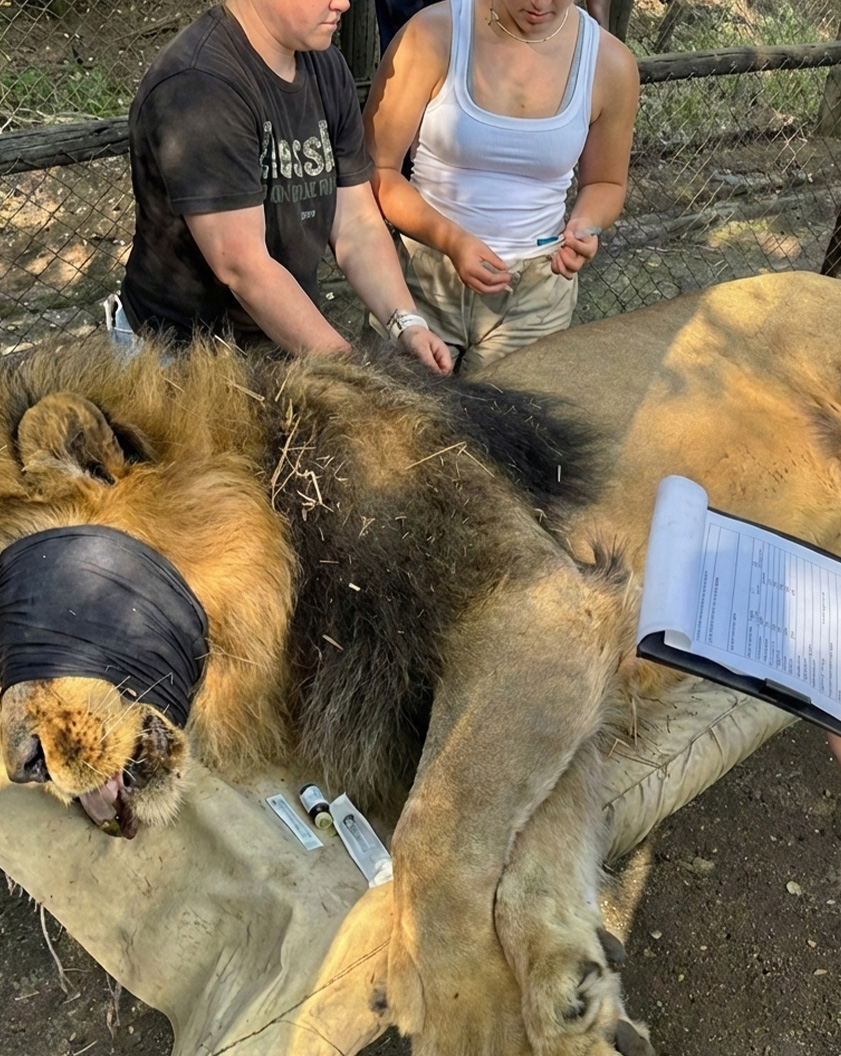
Our wildlife sanctuary is a haven for wild animals which have little hope for survival in the wild – animals or birds which have been orphaned, abandoned, injured, born in captivity or brought up unsuccessfully as pets. It is often the last refuge for those brought in sick or injured, and has increasingly become a sanctuary for confiscated animals.
The wildlife Orphanage was established in 1973 by ex-game ranger Vivian Wilson and his wife Paddy, and its primary function is to offer a home to orphaned, abandoned and sick wild animals. We are not a zoo. Wherever possible, rescued animals and birds are rehabilitated and returned to the wild. If safe release into their natural habitat is not possible, animals are cared for and kept for educational purposes and zoological study. In the case of endangered species, captive breeding programs may be undertaken.
Our sanctuary has been featured in many documentaries and is now world renowned for its pioneering work and is famed as one of Africa’s largest and most successful wildlife rehabilitation/release centres. We are a registered Welfare Organization (38/77) in Zimbabwe.
Our sanctuary is set over 150 acres (60.7 hectares) of land on the outskirts of Bulawayo. There is a private game park attached to the Orphanage. Visitors are welcome to visit the 150+ animals and birds located in the animal Orphanage.
Aims & Objectives
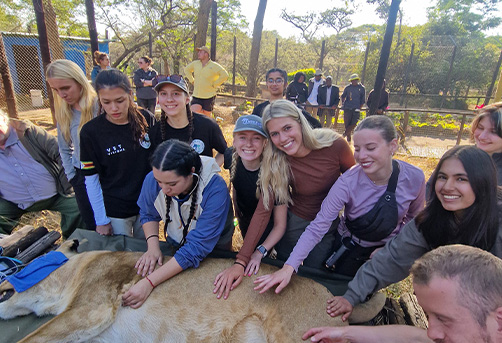
Wildlife Orphanage and Animal Rehabilitation Centre: To rescue and care for injured wildlife, providing a home for the many injured, sick, orphaned, abused, confiscated or abandoned wild animals from anywhere in Zimbabwe.
Education: To educate the Zimbabwean public, especially young children, about the rich wildlife heritage of the country by allowing them to view the many species of carnivores, antelopes, primates, reptiles and birds not easily seen in the wild. EPIC (Environmental Programs Involving Children) Kids runs special environmental outreach in schools in Bulawayo and outlying areas.
Over 40,000 children in 360 schools have attended the Epic Kids educational lecture to date.
Nature Conservation: To teach people and especially children, to appreciate the wonder and variety of indigenous wildlife and not to take it for granted that these animals or their environment will not always be there for their enjoyment without the correct management of our natural resources.
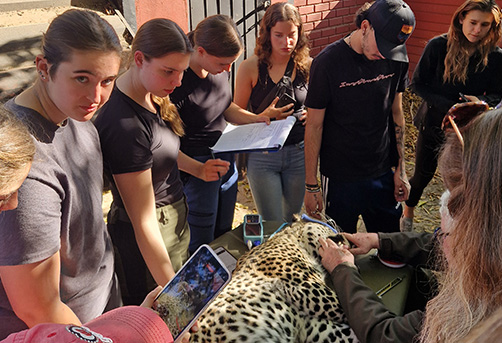
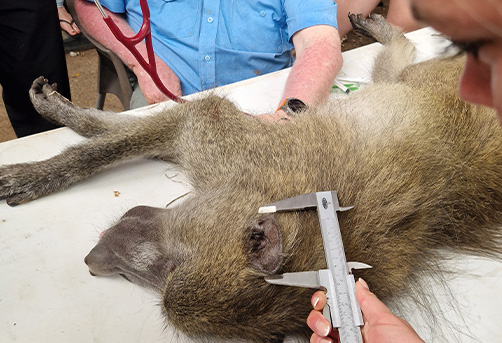
Research: To observe and record useful zoological information on captive animals such as body growth and development, nutrition, dentition and gestation periods. Relevant research and field surveys are undertaken in the wild, under natural conditions in National Parks and protected areas.
Cooperation: To provide a link between local and governmental authorities thus being able to offer assistance to organizations like SPCA, National Parks, schools and private individuals where ever problem animals are concerned.
Meet our animals & Birds
We have many interesting Animals, Reptiles and Birds as both permanent and temporary residents.
Currently, we have the following wildlife duikers, kudu, doves, guinea fowls, serval, bush pig, monkeys, ducks, eagles, leopard, kites, goshawks, peacocks, brown hyena, spotted hyena (Ed J) snakes, zebra, lion, hedgehogs, and baboon.
Program Videos
The volunteer programme
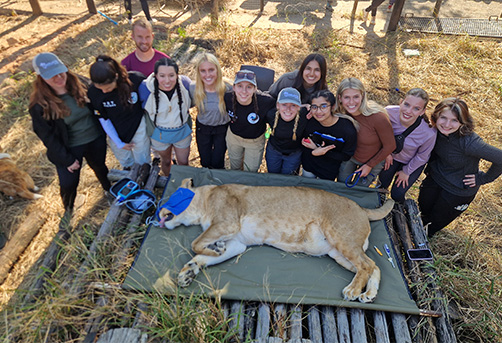
We have starting days every Sunday, departing days on a Sunday as well. We welcome volunteers from all over the world and there is a lot to be done to care for our 150+ animals and birds. As a prerequisite, all our volunteers must be familiar with spoken English and love animals.
Generally volunteers must be between 18 and 50 years of age. However, we welcome the more mature volunteers, as long as they are physically fit. Families are also welcome and we have had grandmothers and their grandchildren; along with parents and children, all volunteering here. Younger volunteers (below 16) must be accompanied by a guardian. We accept volunteers for a minimum of two weeks and you can choose to stay up to six months. Ideally, to get the most out of the project and the animals, a stay of 3–5 weeks is recommended
If you are physically challenged, please contact us and let us know. We are not entirely wheelchair friendly and, for their own safety, cannot take visually impaired or hearing impaired volunteers. If you have any serious medical issues or are on medication, please let us know so that we can arrange for the appropriate care for you in case of an emergency.
Unfortunately, we are unable to cater for vegans or those who are lactose or gluten intolerant. This is due to the lack of availability of food substitutes in Zimbabwe. Thus, if you have a mild food allergy and can bring your own food, please let us know and we can work out a plan for you. Unfortunately, acute food allergies cannot be catered for.
The Life of a volunteer
On arrival at Bulawayo Airport, a member of our staff will meet you and take you straight to the Orphanage. The drive takes about 45 minutes. Depending on what time your flight gets in, you will either be taken straight to your cabin where you can relax before having dinner or. Your orientation tour will be done the following day
Volunteers are expected to work 5.5 days a week and have Sunday afternoons and Mondays off. Babies are still required to be cared for on your days off though. No experience is needed to work with the animals, as all necessary training will be provided. All we ask is that you are enthusiastic and dedicated to working with animals. You will work 7 hours a day but will always be on call during fire season and when we have babies in. Baby shifts will be shared out between the volunteers, as we would not expect them to be awake with them all night.
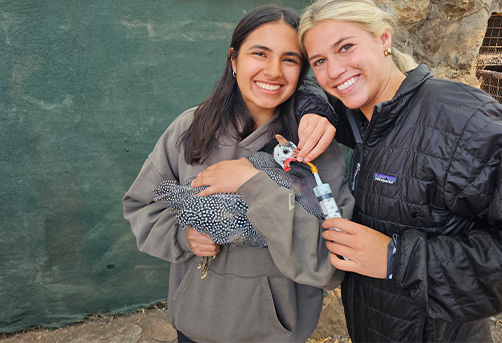
During your first week, you will be getting to know how the Orphanage runs. During this time you will work with the different teams. You will get an introduction into working with the carnivores, primates, birds of prey, reptiles and domestic animals.
Your main duties will include:
- Preparing food for the animals: all the sections are different, as they all require a specific diet.
- Feeding the animals: some of the animals are dangerous, such as the snakes and crocodiles, so the volunteers get to observe while the workers feed them.
- Clean out enclosures, this does include enclosures for the large carnivores.
- Helping with enrichment ideas for the animals.
- Helping to build and maintain enclosures.
- Giving tours and educating the public. Going to the school outreach program and helping with the animals.
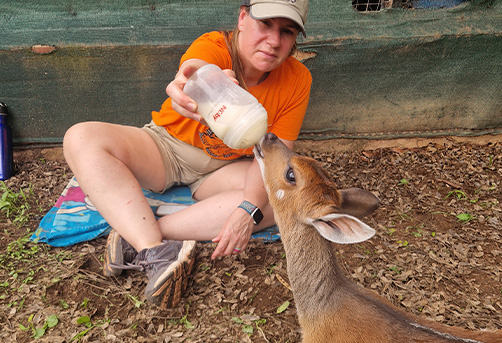
- Hand rearing orphans. This is a most rewarding task, as you get to comfort them when they cry and feed them when they’re hungry. Be warned though! Like human babies, they may need feeding during the night or just need a cuddle when they get scared, so it is likely you will feel tired!
It is important to note that all your work will be for the animals, but not necessarily with the animals. It can be hard work but it will be very rewarding. Do not expect to be spending all your time cuddling baby animals, you will be contributing to the upkeep and your days will be full. You will be enriching the animal’s lives.
No two volunteers will have the same experience. Volunteers are encouraged to keep an open mind and embrace the experience. We can promise that it will be unique and it can be the experience of a lifetime. We trust and will empower you to take on responsibility very early in the volunteer experience. Things may be done differently here from your home country. If you have any concerns, please address these concerns with Mickayla Wilson or a member of the key personnel to discuss your concerns.
Also, we recommend that you make your travel plans to arrive on a Sunday so you have time to rest and get over the jet lag. We are flexible though, if the most convenient flight connection can only bring you on another day of the week.
The Volunteer Camp
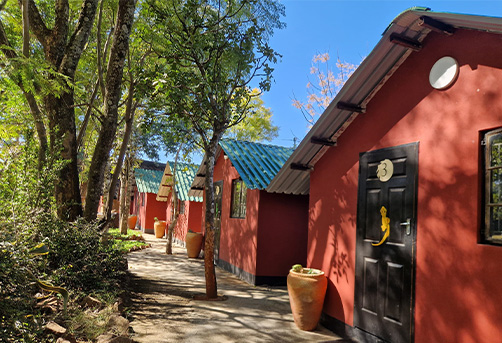
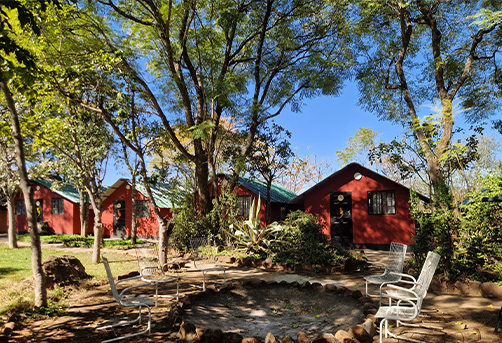
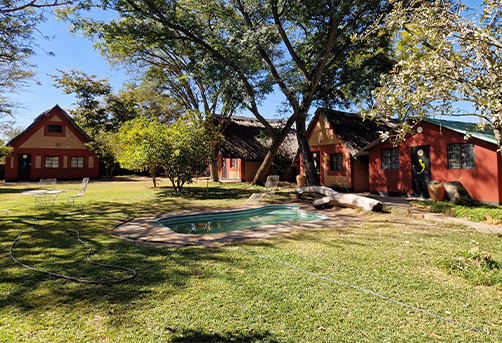
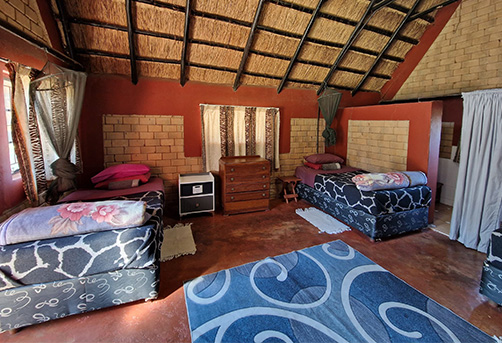
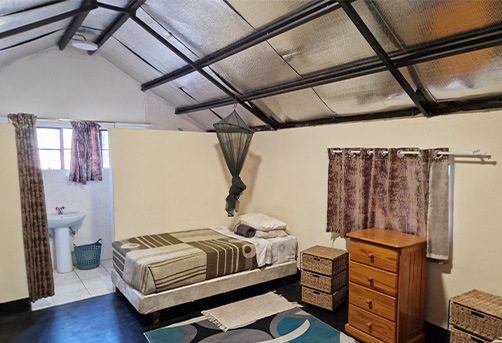
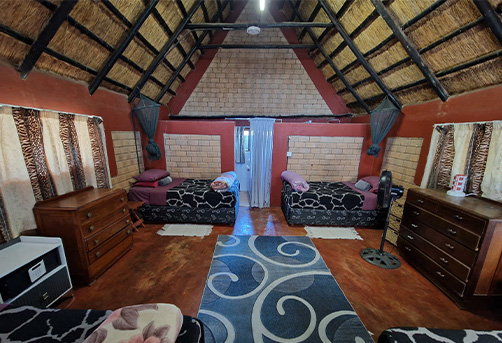
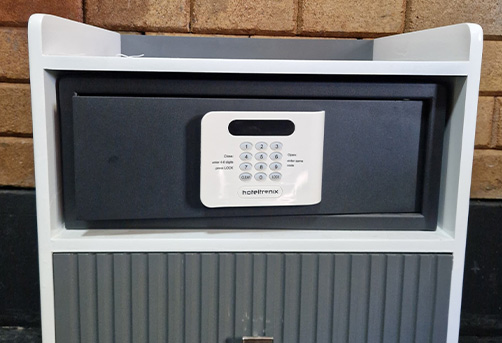
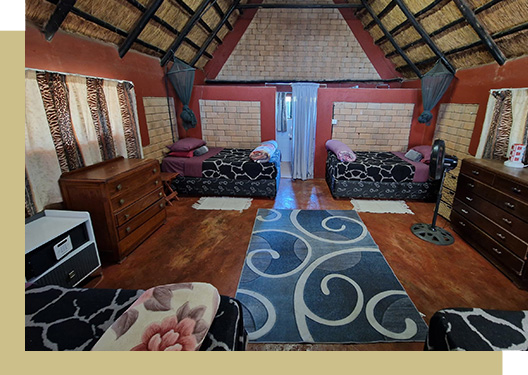
The living accommodation is in comfortable cabins with electricity. Depending on how many volunteers we have at the time, you could have a cabin of your own, equipped with a comfortable bed, mosquito net, cupboard or shelves and bedside table with a safe. In some circumstances you could be with other volunteers.
With regards to family groups, we have family rooms. All of the rooms have bathroom en-suites, however, there are communal ablutions available. In the camp there are hot water showers, flushing toilets, a braai/BBQ area, a kitchen and a swimming pool. You will be provided with clean sheets, blankets and a swimming towel. Your laundry, excluding personal items, is done twice a week and will be freshly ironed by our staff.
We have 3 meals served a day, which includes a vegetable dish. These vary on a daily basis. These meals are all prepared for you, but you can make a request if you would like something special. Unfortunately, we cannot cater for vegans and those who are lactose or gluten intolerant due to the lack of availability of food substitutes in Zimbabwe. Tea, coffee and cordials are available all day.’
There is an entertainment room/lounge especially for volunteers. This has a projector connected to Netflix, a library of novels and educational and reference books. For after dinner ‘entertainment’ you may play a game of darts, board games or just listen to music.
Average day at the Sanctuary
There are no “typical” days as each day can throw up a new challenge. You will be allocated into groups every week and given new tasks daily. Your day might start at 08h00 with feeding of the babies, then cleaning an animal enclosure and changing their water. Then you could go on to enjoy the daily ‘Animal Time’. This is from 11h00 to 12h00 (noon) which allows volunteers to spend quality time with the animals or birds in the Orphanage. After a lunch break, you will resume work, which may be feeding of the animals, bringing in fresh branches, some baby duties or going to the local schools with kids. At 17h00, you finish work unless you have baby duties. Dinner is at 18h00 and post dinner, you can chill by the fire, chat to friends and family at home or just socialise with the other volunteers.
What the Volunteer Donation is Spent On
While we are keenly engaged in sponsorship campaigns from the surrounding community, every penny/cent that you pay as a volunteer is used to subsidise and offset the high costs incurred in the running and maintaining of the Orphanage.
Your donation also includes all living expenses, all your food and maintenance of the cabins. This also incorporates a pick up and drop to the airport. We also take you to town once a week where you will be able to shop for personal items, treats and gifts.
What to Bring
- Old clothes, your clothes will get dirty and ruined so we do not suggest buying new clothes. You may like to bring some nice clothes for the evening and trips.
- Warm clothes, during the winter months, June, July and August as the nights can be colder than expected.
- A flashlight, Zimbabwe is known for its power cuts, so it is a good idea to bring a flashlight for these times. We do have a generator so we can get power in the cabins for a couple of hours. We also have a gas stove so you will never go hungry!
- 2 pairs of protective gloves as you may need to protect your hands from thorns or wires.
- An alarm clock (your cellular device has an equally effective option) and a watch.
- Toiletries and a bath towel.
- A First Aid kit, (Contents: antiseptic cream, anti-diarrhea pills, re-hydration tablets, headache pills) along with all personal medication. IMPORTANT: Anti-malarial medication, if you are planning on visiting areas in Zimbabwe that are high risk malaria areas.
- Insect repellent.
- Sun cream and after sun cream. You will be working in the sun and will need protection no matter what time of year.
- A sun hat and light weight shirts/blouses to protect against the sun.
- Swim wear.
- A waterproof jacket for our summer months.
- A pair of sturdy shoes or boots, for working in the field.
- Flip flops or sandals for light work and days off.
- Powerbanks to charge devices in case of power cuts
- Some spending money. You won’t need much unless you are going to do a trip but there are ATMs in Bulawayo.
- Mobile phone to access the internet and communicated with family and friends back home.
- Long sleeved shirts / Long trousers / Jeans.
- IMPORTANT: Always have photo copies of your important documents such as your passport, insurance and flights, it is also a good idea to leave a copy at home with someone you trust and scan a copy and send it to your email.
If you forget something… that’s okay, as mostly everything you want we can get from town.
Donation / Wish List
If you have extra space in your bags, we are always grateful for donations in the form of notebooks (not the electronic kind), pens, pencils, crayons and pencil boxes (especially for the kids program!) Blankets or Sheets for the young ‘babies’ or animals when they are sick.
Monetary donations are always welcome and depending on your budget, you can contribute to either maintenance or something substantial like a new enclosure or a shelter. You can also encourage your friends and family to make a donation – in cash or kind.
The Culture Shock
Please remember that you are coming to Africa… thus things will likely be very different from what you may be used to back home. But then, that’s why you are visiting …for the experience and the amazing wildlife!
The food will be cooked differently and the taste may differ from what you are used to; the weather may be different; you will see some insects, spiders and bugs – both inside and outside.
As we have already mentioned, there can be frequent power cuts and while we will always give you warm food and warm water, the electricity can be off for a long time.
People are friendly but a ‘tourist’ tends to stand out more and are inclined to attract unwanted attention or pushy sales people.
We will always escort you to town or to the supermarket or the museum. That said though, we urge you to be careful and take good care of your belongings. Do not leave your passport, money or your phone unattended. Please use the safes provided for your valuables as theft is a problem.
Dress for the weather but remember that even in the winter, days can be very warm days and the nights very cold. You will likely find squirrels, birds and other animals on the roof of your cabin and they may wake you while you sleep. We hope you don’t become homesick but if you do, please let us know and we will do our best to help you settle in.
We want you to have a rewarding and enjoyable experience with us. Some of our volunteers have enjoyed their experience so much that they come back for a second and even a third time.
Please be aware that our sanctuary is often the lifetime residence of some of our animals, which are too tame or injured to be released in the wild. All our animals, except the babies, are in enclosures however, we are not a zoo.
Local Information & Trips
We can arrange trips for our volunteers to take a break and see some of our beautiful country. Currently, we offer a day trip to the Matopos for the rhino walk a trip to the majestic Victoria Falls and Masvingo to see Great Zimbabwe. All these trips have a minimum of for people that needs to be met for the trip to happen.
Bulawayo is the second largest city in Zimbabwe, the actual city does not contain many tourist things to do but does have an excellent National History Museum and enough supermarkets for all the stuff that you will require. It does have a lot of interesting things close by like the Matopos National Park that has the highest concentration of leopards in all the national parks.
RHINO WALK
A day trip to the Matopos (Matobo National Park) which includes a walking safari with the rhinos and a trek to a bushman art rock cave. It is a full day out and a really incredible experience to be able to get within a couple of feet of some of the rhino. It is US$130 per person, all inclusive. This can be paid before arrival through your agent or in cash on arrival
VICTORIA FALLS
Depending on how you prefer to spend your leisure time, Victoria Falls offers a wide range of exciting and relaxing activities. You may choose to go bungee jumping off the famous Victoria Falls Bridge, experience white-water rafting on the mighty Zambezi River, or enjoy a leisurely walk through Victoria Falls National Park to witness “the Smoke That Thunders,” one of the Seven Wonders of the World. To end the day, you can take a peaceful sunset cruise and observe wildlife bathing along the riverbanks. There are many other activities available to enjoy during your stay at the Falls.
You will fly to Victoria Falls with FastJet, and flights can be booked either before or after arrival. A staff member will assist with transportation to and from the airport. Prior arrangements have been made for a reliable taxi driver to collect you in Victoria Falls and return you to the airport on the day of departure. Accommodation costs range between US$60 and US$160 per person for two nights, depending on the room selected. Activities in Victoria Falls are paid for locally and can be settled by card (VISA / MASTERCARD only).
GREAT ZIMBABWE RUINS
The Great Zimbabwe Ruins are an ancient stone settlement built on a hilltop and are one of the most important historical sites in Southern Africa. This site is where the name of the country Zimbabwe originates, derived from the Shona phrase “Dzimba dza Mabwe,” meaning “houses of stone.” This experience is offered as an overnight trip and costs US$150 per person, all inclusive.
Visas, Weather & Other Important Information
Visas: are issued at the port of entry and are normally given for 30 days but this is subject to change. Certain countries need to apply or visas in their home country. Others can apply at the airport for a visa on arrival. Consult www.zimimmigration.gov.zw/index.php/visa-regime before you book your flight, to understand the visa regime for your country. For most nationalities, there is a visa fee but it is best to check before you leave and have enough money in US$ to pay.
Vaccinations: make sure your tetanus is up to date, you will be working with wild animals. Also Hepatitis A and B and Typhoid are recommended. Malaria is not found in Bulawayo but is recommended if you intent to travel to Victoria Falls
Currency: Local currency is the US Dollar.
Adaptors: The adaptors used are the 3 round pinned South African (M Type) and 2 pinned European.
Internet and Wi-Fi:. Complimentary 1GB of Wi-Fi will be given to volunteers on arrival so they will be able to contact home and tell family that they have arrived safely. We then have 10GB vouchers available at $15 each. In this way all volunteers should be able to have Wi-Fi facilities to meet their FaceTime, WhatsApp, Facebook and other social media needs. Please note however, that during power failures the Wi-Fi network could be intermittent. Sim cards can be purchased in town as well as data if anyone should require them but the coverage at the orphanage isn’t very reliable.
Money and Financial Affairs: Cash – Zimbabwe is currently experiencing a shortage of cash. We therefore suggest that every volunteer brings with them a minimum of $700 in US$ cash for a 2 week period and an additional $200 per additional week. Please note that cash is available from the local banks for ATM machines but isn’t guaranteed .
Credit Cards: Please note Visa and MasterCard are the most acceptable companies, with Visa being the most preferred. Maestro as well as Revolut and some of the less known credit cards will not be accepted in Zimbabwe. Please check with your bank to make sure that your credit cards/debit cards are approved for use in Zimbabwe. Credit cards can be used for the purchase of all your treats, i.e. chocolates, sweets etc.
Alcohol: Due to the fact that alcohol in Zimbabwe is relatively cheap compared to international standards, binge drinking and wild partying will NOT be tolerated. Where offenders are not prepared to follow the rules, they will asked to leave the project. The drinking of alcohol is only permitted on off days – when you will have no interaction with the animals. Please note that the legal age for drinking in Zimbabwe is 18 years, thus, any volunteer under 18 years of age will not be permitted to drink. Whilst we all enjoy having a drink or two around a camp fire and looking at the beautiful African sky, excess drinking is prohibited.
Weather: The climate is hot all year round but during the winter months the temperature can drop considerably overnight.
Travel Safe
For some of our young volunteers, travel to Zimbabwe may be their first international trip alone. It is perfectly safe to travel here but please use common sense and basic safety precautions. In other words, be ‘street smart’ and observe the same precautions if you were visiting any other large city.
Keep your travel documents safe and on you at all times. The process of replacing your passport should it be stolen, is both arduous and tedious. DO NOT leave your luggage unattended, even if you are going to the bathroom. DO NOT carry cash in a single place, it is best to distribute it between your bag and your person.
When you apply for your visa, do not disclose you are a ‘volunteer’ as the customs / immigration do not understand the concept. Say you are travelling as a tourist. Be polite to all officials and treat them with respect, as that is what they are used to. Should you be unfortunate enough to misplace your luggage or have any other problem, try not to get upset. Continue outside the airport to where one of us will be waiting and we will sort it out for you.
In most tourist places, there is the ‘local’ price and a ‘foreigners’ price. Please be aware of this and accept it as common practice.
There is a lot of poverty around. Keep your wits around you and stay safe.
Our Volunteers Love Us